Desk
An alternative portfolio that lives on my desk. Instead of a list of pages there is a room you can look around: a computer you can zoom into, polaroids you can pick up, a notebook and a phone that still dials.
Design, 3D and development, 2026
The idea
A portfolio has to be clear, immediate and to the point. That is often what makes it boring: it shows the work and loses the personality of the person who made it.
So I made a second one that behaves like a place, where the work sits inside the computer, the photos on polaroids and the notes in a notebook.
It is deliberately hard to find your way around, because it is meant to be a game. The serious portfolio is the one you are reading.
I hid easter eggs that nobody explains how to find. Only a creative and curious visitor will see them all.
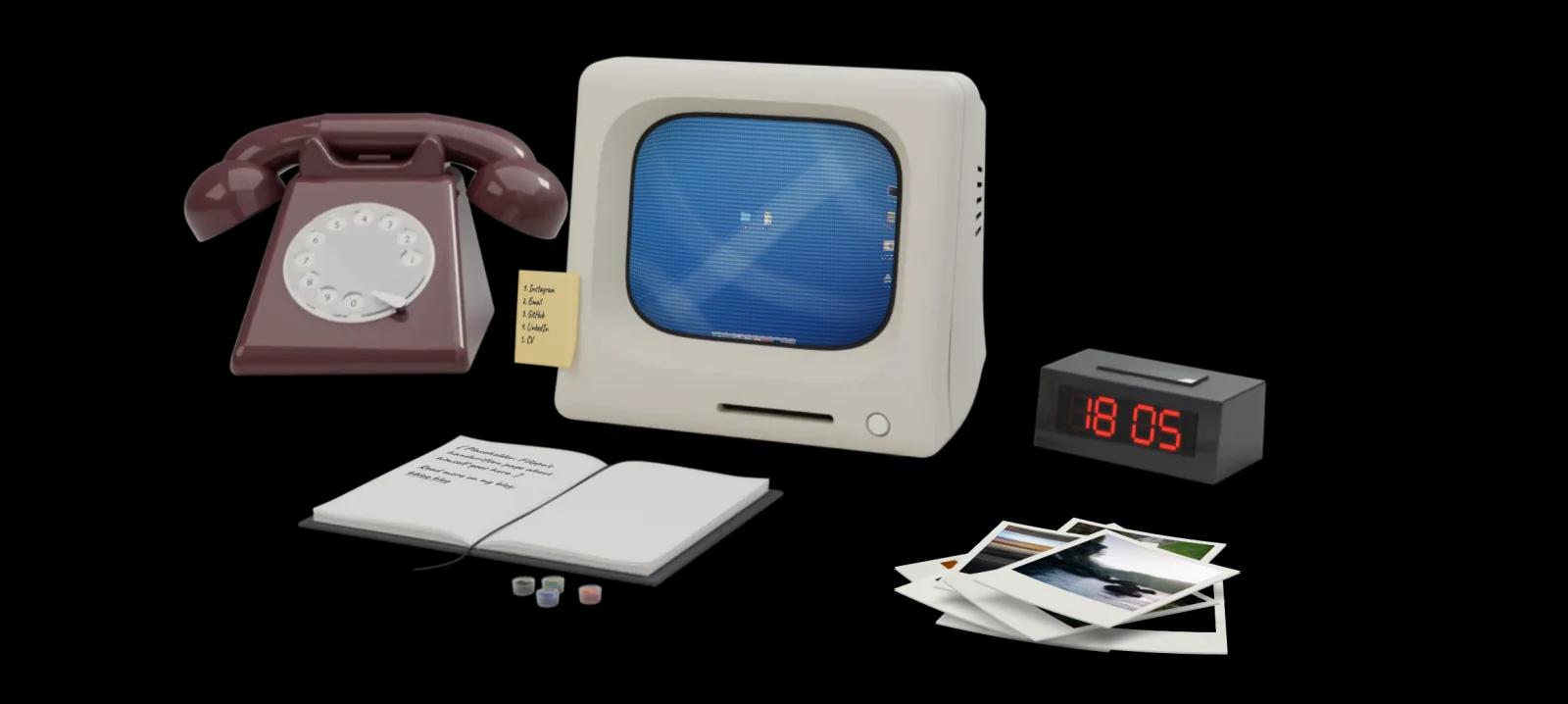
Made in Blender
Every object on the desk is made in Blender: the computer, the phone, the clock and the notebook.
The rest is not in Blender. The polaroids, the time on the clock, the writing on the Post-it and in the notebook, and the page on the screen are drawn live by the browser, on top of the render.
Drawn live by the browser
- The polaroids
- The ink in the notebook
- The list on the Post-it
- The time on the clock
- The page on the screen
The render from Blenderone of 23 still pictures
Rendered ahead of time
Nothing on the desk is a real-time model. The scene is rendered in Blender from 23 camera positions, on a transparent background, with a floor that only catches shadows. A script converts the renders for the web.
As the mouse moves, the page moves between the 2 renders closest to it. The browser never computes the light, so the room keeps the shadows of a full render and still follows the cursor.
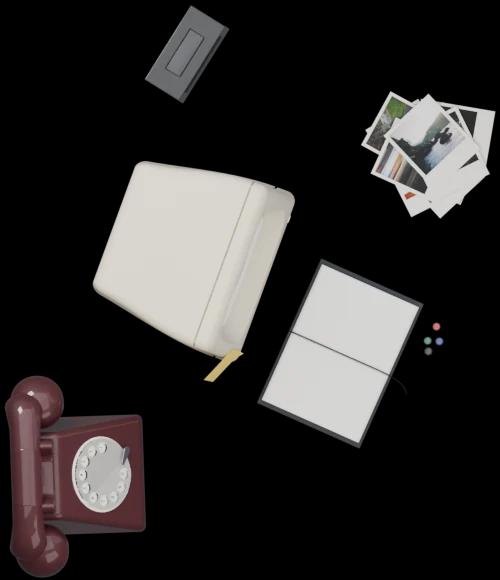
Drawing on a picture
A render is only a picture, so each one is exported with its geometry: where the glass of the screen lies, as a grid of points, and how the camera projects the desk, as a matrix.
With those numbers the browser can draw on exact places of the render. The polaroids can be dragged and piled up, the ink paints the notebook’s page, the phone’s dial turns and the Post-it carries a list, all on top of an image that never changes.
Through the screen
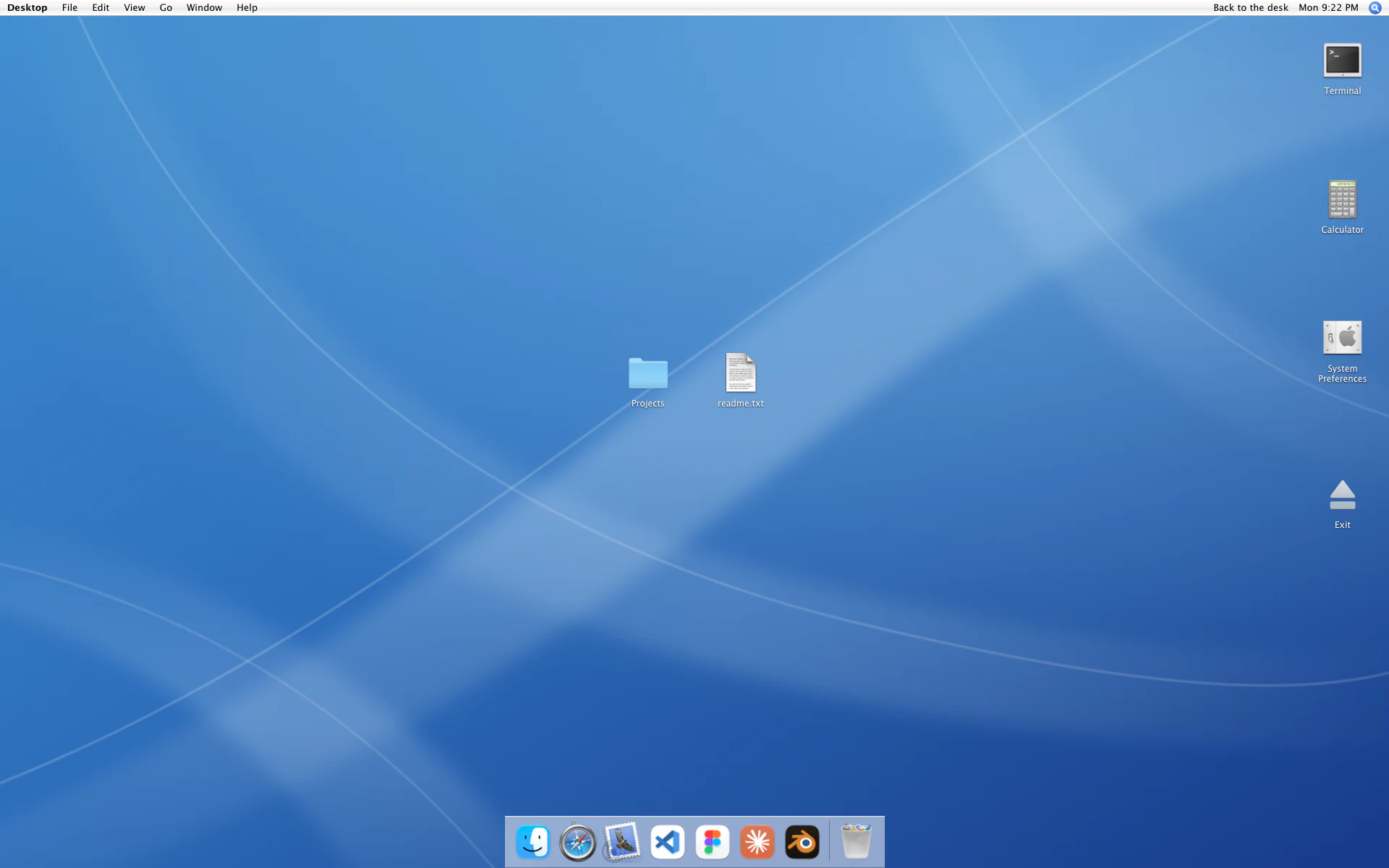
Clicking the screen pushes the camera through the glass, and what was a picture on a tube becomes a page you can use. On the desk that page is drawn with a CRT shader, so it belongs to the room before you enter it.
Inside there is a desktop in the style of Mac OS X Tiger. Its controls follow a small design system, with menu bar, windows, buttons and tabs measured on Tiger’s own screens.
Camera flights
Every object you can approach has its own camera move. The polaroids and the notebook are flights of 90 rendered frames, played from a single click. The phone and the Post-it beside it get a close-up, a separate render that grows until it fills the window in 1.1 seconds. The computer is the 1.4-second push through the glass.
The hard part was making the flights feel like one movement. Blending 2 frames left a double image, because the picture moves up to 43 pixels between them, so each tick now shows one sharp frame. Frames are sent to the graphics card ahead of the camera, and the picture grows along one continuous path until it fills the window.
The sounds
The objects you touch on the desk make sounds. Only 2 are audio files: a rotary phone being dialed, cut into clips for each digit, and the sweep of going inside the computer. All the others are made in the page from noise and tones, and every level was chosen by ear.
The polaroids are soft hits of paper on wood, the pen hisses like a felt-tip as fast as your hand moves, and the computer switches on with the clack of a relay and a rising hum. Even the camera moves air, strongest in the middle of a move.
How it feels should not be spoiled. It has to be tried.
Where it stands
Desk is close to finished and will go online soon.